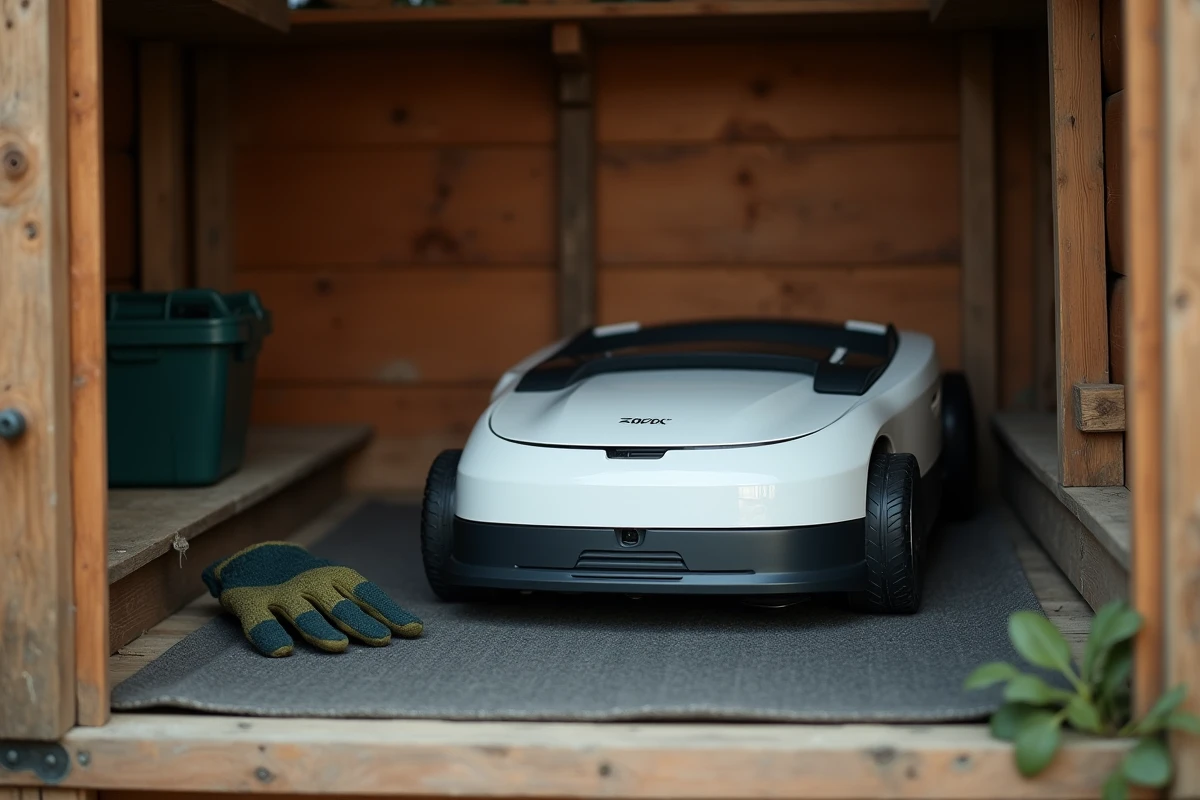
A robotic lawn mower left outside unprepared between November and March suffers from silent degradation: corrosion of contacts, loss of battery capacity, and mechanical blockage of the blades. Properly preparing for winter storage determines the quality of the restart in spring and the overall lifespan of the device.
Lawn Mower Battery: The Critical Point of Winter Storage
The lithium-ion battery is the component most sensitive to cold and prolonged inactivity. Storing the robot in an unheated garage where the temperature drops below zero accelerates cell degradation. Capacity lost during a poorly managed winter cannot be recovered.
Before storing the device, the battery charge should be around half of its capacity. A battery stored at full charge or completely empty degrades faster than a battery maintained at an intermediate level. This principle applies to all lithium-ion battery devices, and the robotic lawn mower is no exception.
The most common mistake is to leave the robot plugged into its charging station all winter. Repeated maintenance cycles unnecessarily stress the cells. Conversely, forgetting the battery for several months without any intermediate charging can cause it to drop below a critical threshold. A check every two months, with a short recharge if the level has dropped too low, is sufficient to preserve the health of the cells.
The ideal storage location is a dry space, protected from frost, with a stable temperature. A temperate cellar or a technical room is better than a poorly insulated garden shed.
Several guides detail best practices for winter storage of the robotic lawn mower, particularly regarding charge level management and appropriate inspection intervals for each brand.
Cleaning the Robot Before Winter: What Happens Under the Chassis
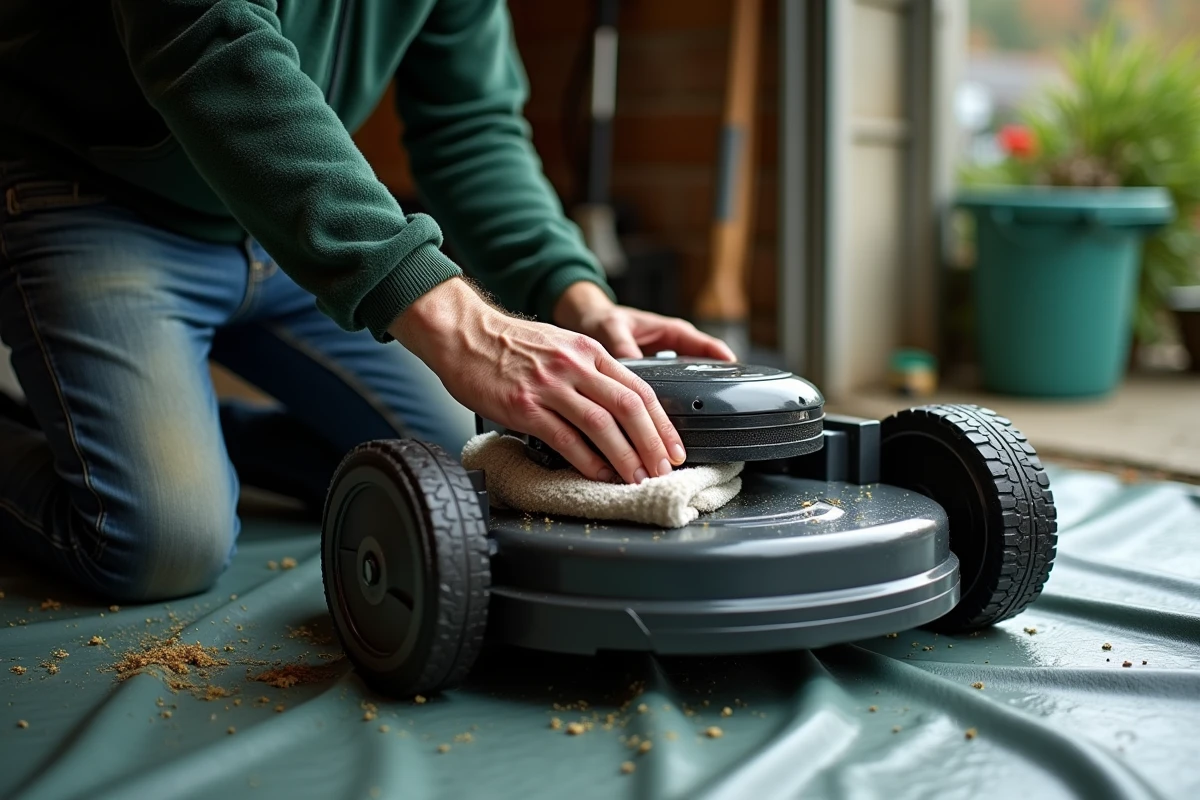
Storing a robotic lawn mower without cleaning it is like sealing moisture and grass residue against the mechanical components. Grass stuck under the chassis retains water, and this water causes corrosion on the axles, screws, and electrical contacts.
The cleaning of the chassis and mowing deck should be done with a dry brush or a damp cloth. High-pressure water jets should be avoided: they force water into joints and connectors, creating exactly the problem we seek to avoid.
Three areas deserve special attention:
- The blades and their support: remove embedded plant residues, check the cutting condition. Dull or chipped blades should be replaced before storage, not in spring when stocks are tight.
- The wheels and their axles: remove compacted dirt that blocks free rotation. An axle stuck by dried mud can strain the motor upon restarting.
- The charging sensors and contacts: a simple wipe with a dry cloth removes the nascent oxidation film. Dirty contacts prevent proper recognition of the station in spring.
Charging Station and Peripheral Cable: Common Mistakes in the Garden
The charging station is often forgotten in the garden all winter. Frost, constant moisture, and UV rays degrade the connectors and weaken the casing. Bringing the station into a dry location significantly extends its lifespan.
The buried or ground-laid peripheral cable does not need to be removed. However, checking its attachment points before winter avoids unpleasant surprises in spring. A cable lifted by frost or cut by gardening tools creates an inconsistent mowing perimeter that the robot does not always clearly indicate.
For installations with a guide cable, the same logic applies: inspect the connections and exposed areas (gate passages, flowerbed edges) where the cable undergoes mechanical stress.
Unplugging the Power Supply
Leaving the transformer plugged in for months without a connected robot wastes electricity and exposes the circuit to winter surges. Unplugging the power supply and storing it in a dry place remains the simplest and most often overlooked precaution.
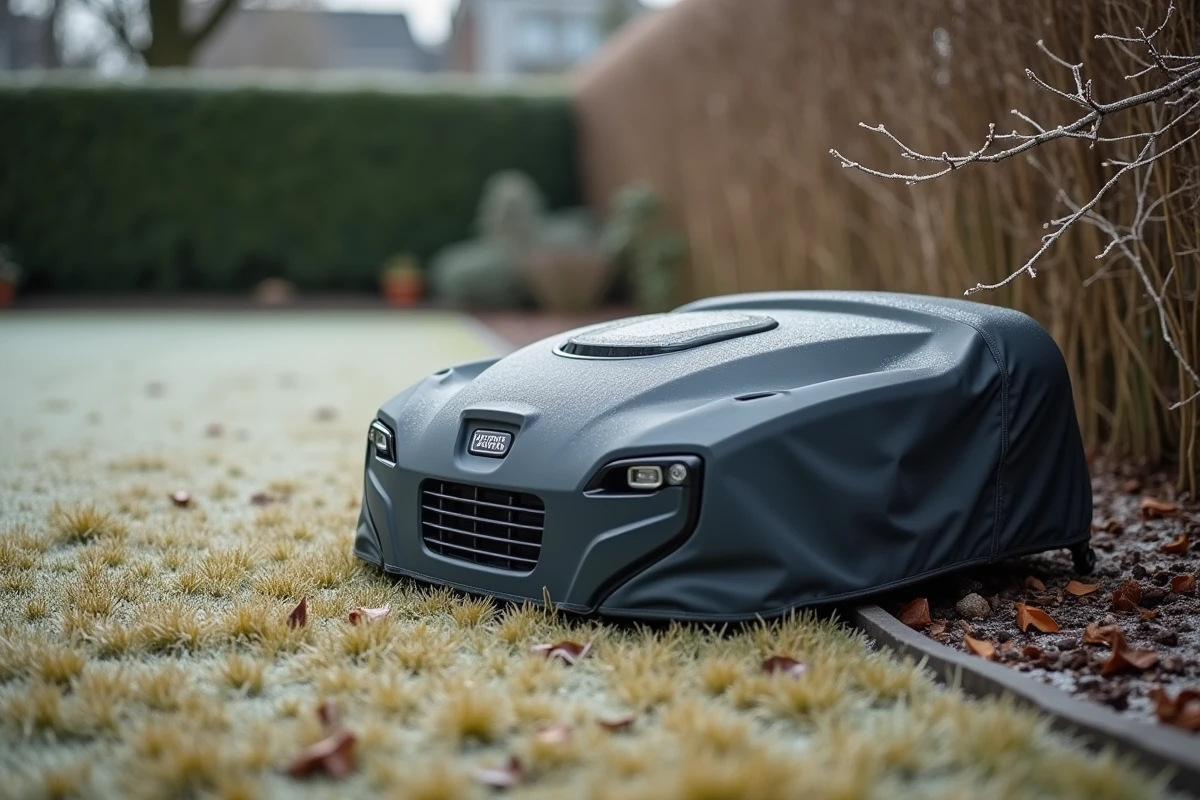
Restarting the Robotic Lawn Mower in Spring: Prepare the Lawn First
The restart does not begin with the robot, but with the garden. After a full winter, the lawn presents areas of moss, debris (branches, pine cones, forgotten toys), and often too much grass height for immediate autonomous mowing.
A robotic lawn mower works by mulching at a low cutting height. Sending it directly onto grass several tens of centimeters high overloads the motor, prematurely wears the blades, and produces a poor result. A first manual mowing at an intermediate height prepares the ground.
- Remove all objects and debris from the mowing perimeter before restarting the robot.
- Check that the peripheral cable emits a correct signal by testing the station.
- Reinstall the new or sharpened blades that were prepared in the fall.
- Restart the robot on a reduced program for the first few days to observe its behavior on the ground.
The first mowing sessions in spring also serve as diagnostics. A robot that deviates from its path, cannot find its station, or stops for no reason indicates a problem that arose during winter: cut cable, faulty sensor, or battery whose capacity has dropped.
The quality of the restart directly reflects the quality of the winter storage. A cleaned robot, a battery stored at the correct level, a station kept dry, and a prepared garden allow for effective autonomous mowing from the first weeks of regrowth.